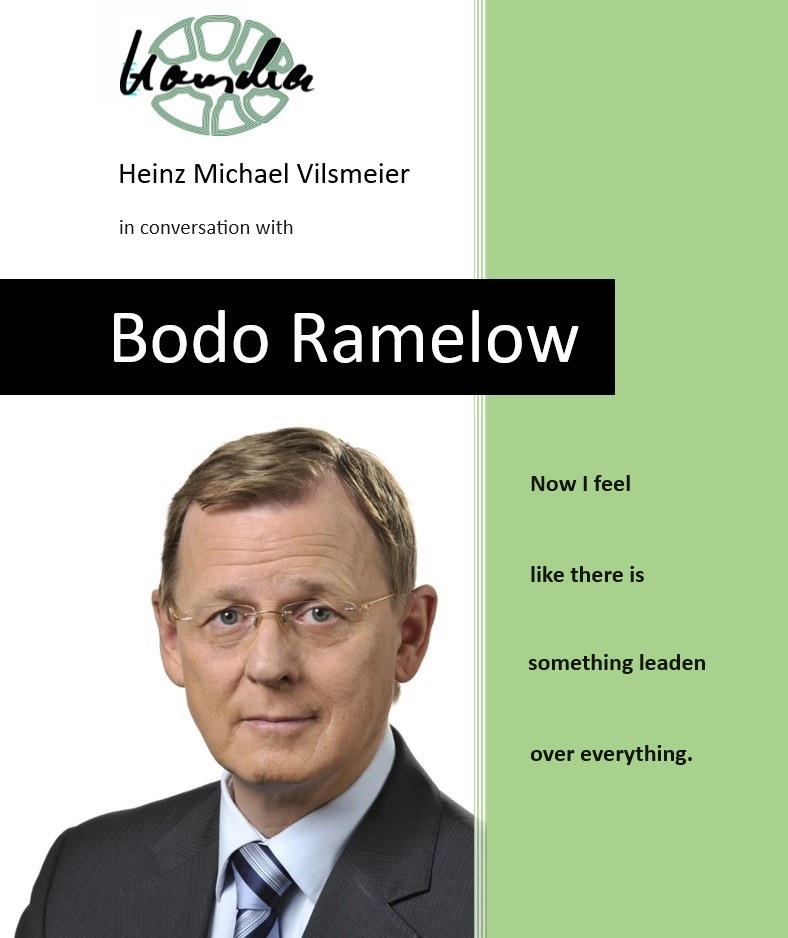
Bodo Ramelow
Now I feel like there is something leaden over everything.
E-Book: 1,99 €
When Bodo Ramelow said on 1 September 2013, “Now I have the feeling that something leaden hangs over everything,” the federal election was only a few weeks away. Ramelow, then parliamentary group leader of the party DIE LINKE in the Thuringian state parliament, was describing not only a snapshot but a widespread sentiment: a society weighed down by heaviness and rigidity—and a politics that increasingly presents its decisions as “without alternative.” Where those in power claim infallibility, resistance to the diktat of purported inevitability grows—and with it the turning away from the governing parties. This disappointment, however, did not remain without consequences: some sought support in far-right extremist groups, others in the hope of a democratic, emancipatory alternative.
Against this backdrop, the conversation aimed to clarify whether and how DIE LINKE has a concept for winning back the disappointed for progressive politics—before resentment and radicalization fill the gap. The fact that Ramelow made history a few months later as the first Minister-President from DIE LINKE in a German federal state gives the interview added sharpness. Especially since the 2013 federal election, in arithmetic terms, produced a red-red-green majority—and yet everything turned out differently.
The interview appeared under the title “Now I have the feeling that something leaden hangs over everything.”
Sample reading
The following excerpt comes from the full interview that was published in the publication.
HAMCHA: Good morning, Mr. Ramelow. – Why are you on the left?
Bodo Ramelow: Why am I on the left? – I come from an old, Protestant, conservative family where the issue of social responsibility has always played a central role. It was the question of responsibility, especially for other people or for societal developments. In our family, there has always been a strong affinity not only to focus on oneself but actually to care that one can only be well if those around are also doing well. – If there is a perspective there. That’s a fundamental attitude that has been instilled in me from the cradle in my life. The question of party political affiliation only came to me many, many decades later.
I have been a trade unionist, I have been a works councilor, I was involved in the peace movement in the 1970s. It wasn’t until 1999, here in Thuringia, that I became a member of a party, namely the PDS at the time. The reason was, today is September 1st, the International Day of Peace, the bombing of Serbia, German involvement in a military operation, in a war effort, which deeply affected me. At that time, I became a member of the PDS, with the message: „I am joining this party to contribute to making it a party for all of Germany, a socialist party.“ In Germany, socialism has always been translated, especially in West Germany, through anti-communist currents and the Cold War, with terms like SED, the Berlin Wall, STASI, the Gulag, and other things. My vision of a different society is much more than a reduction to state capitalism as seen in Eastern European countries.
HAMCHA: Your family, as you mentioned, is Protestant and conservative. Was your path into the politically left-wing camp accompanied by conflicts against this background or was it accepted by your family?
Further interviews with Bodo Ramelow: